Artika Studio
Upload a room photo, then generate, recolour and photorealistically place framed artwork on the actual wall — with size recommendations and an exportable placement report.
- Role
- Architect & sole engineer
The application
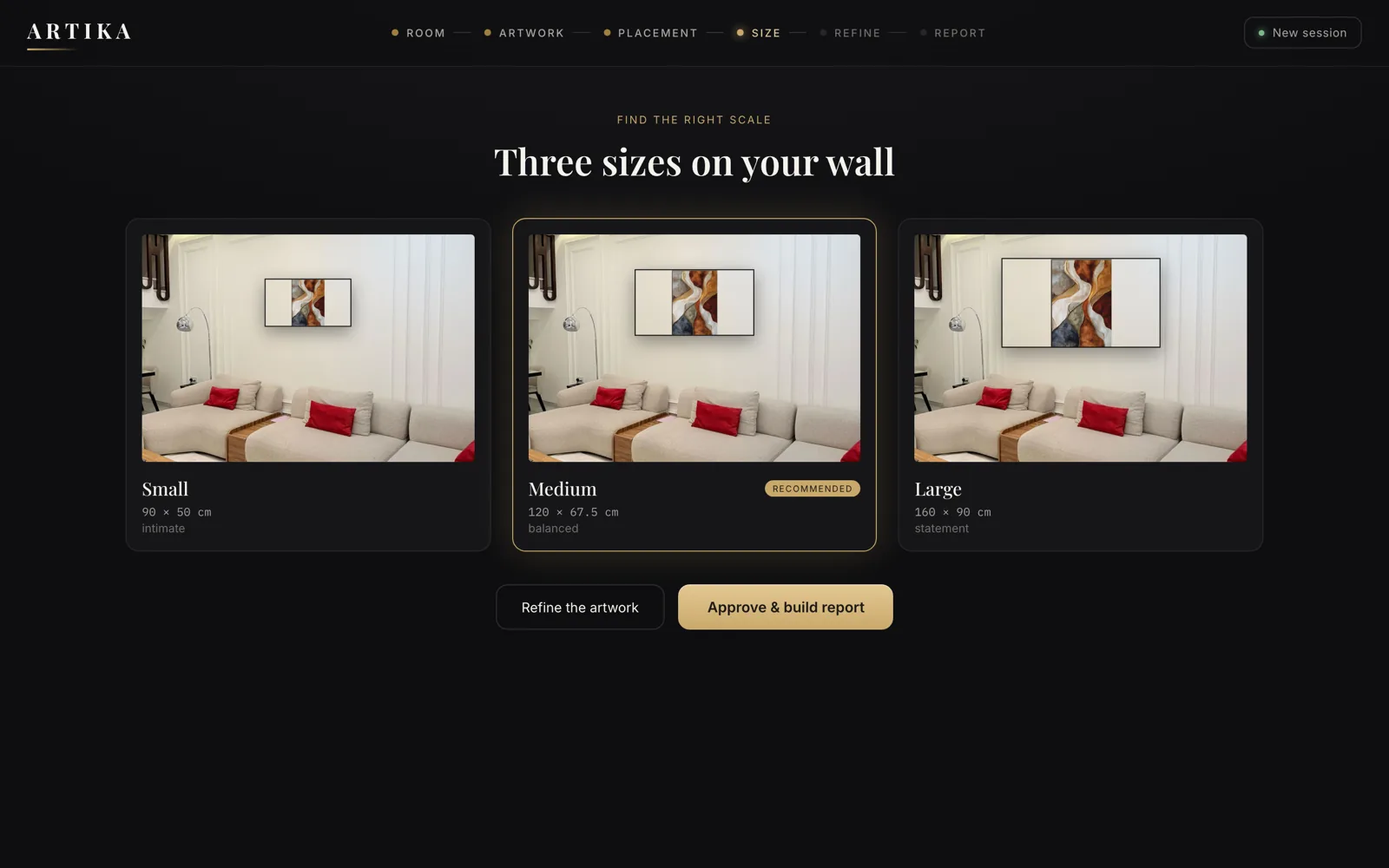
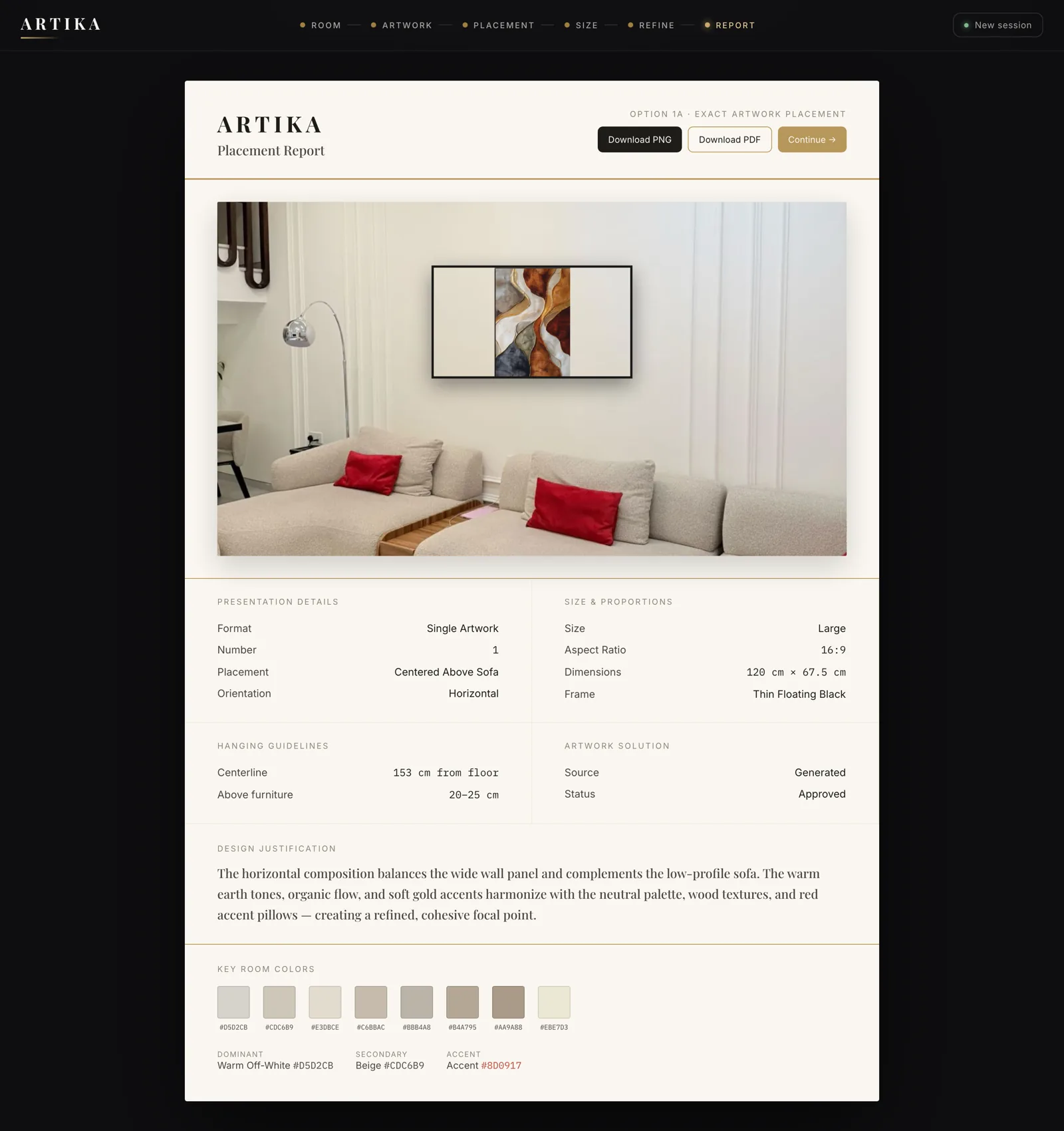
Screens, captured from the running app
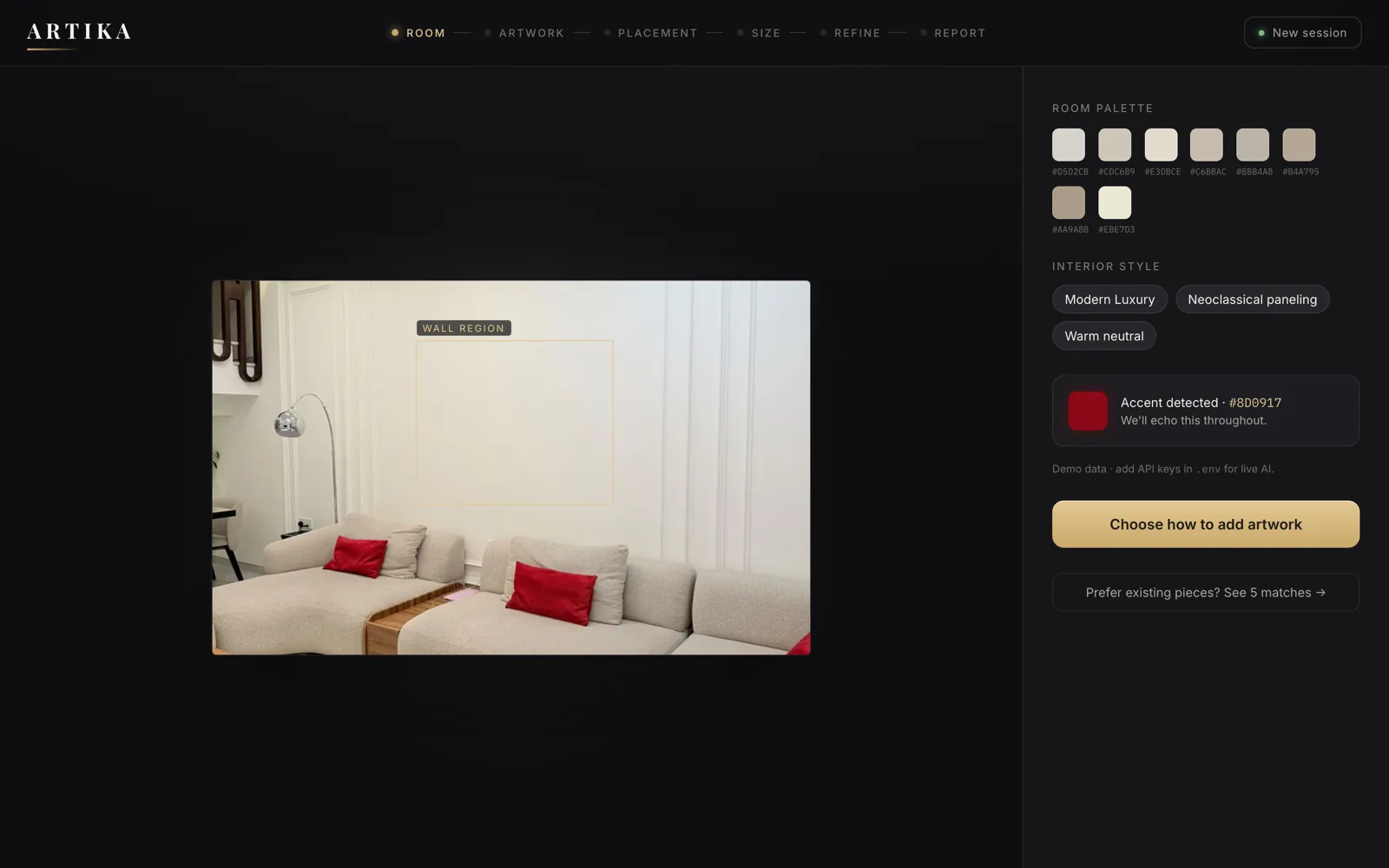
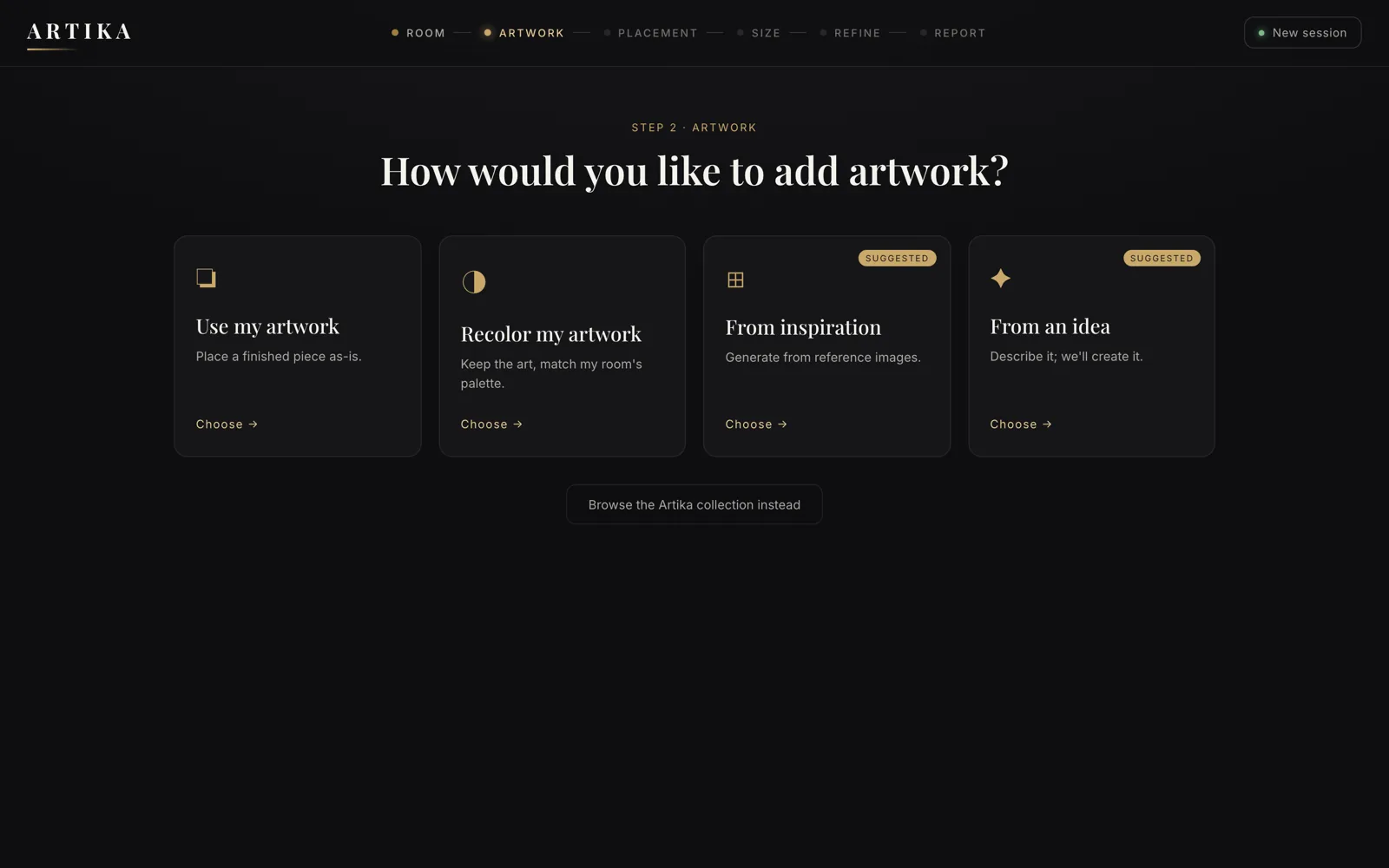
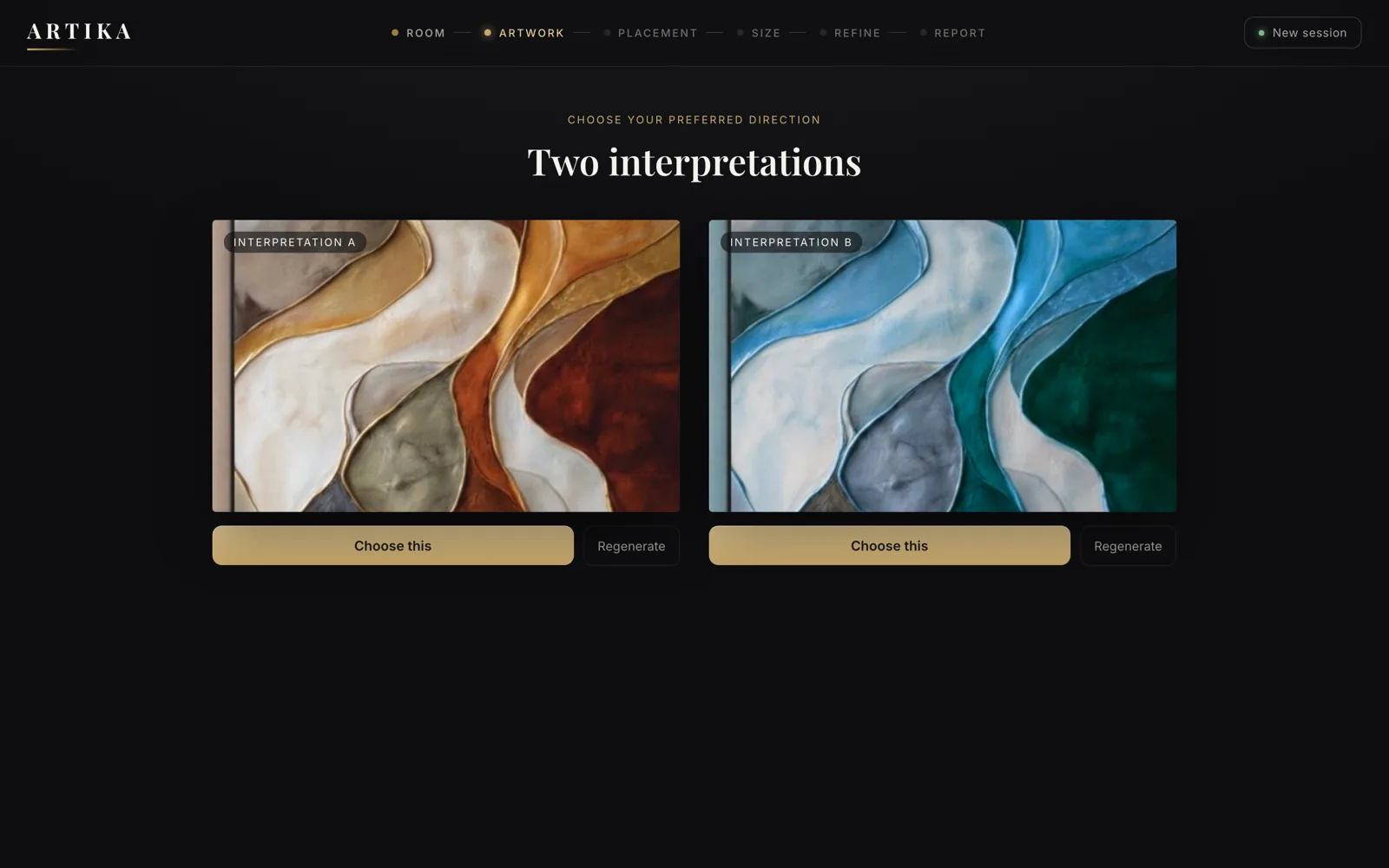
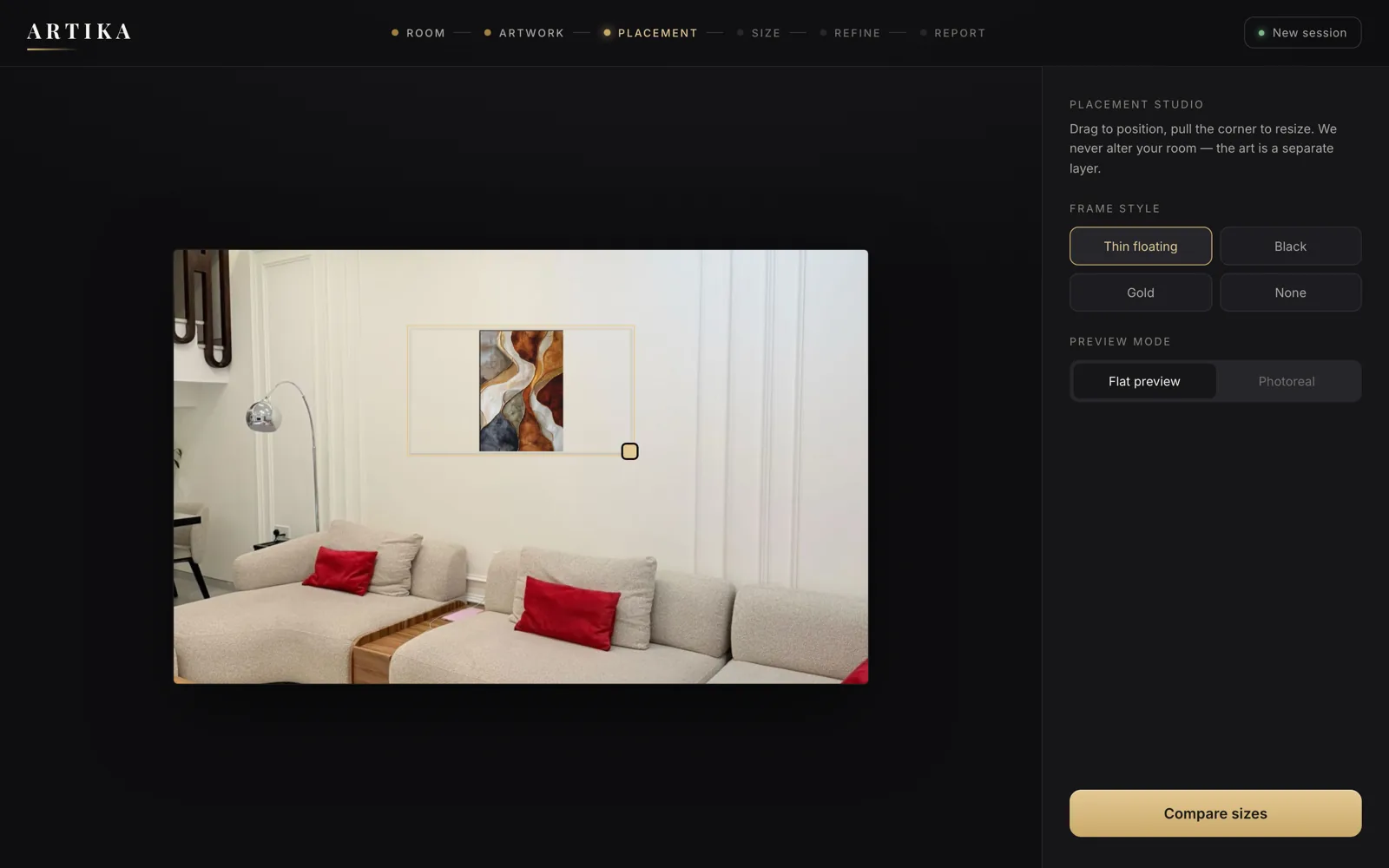
Captured by driving the ten-step flow end to end with no API keys configured — the room analysis is really computed, the generated pieces are the bundled fallbacks, and the app labels which is which.
The problem
Buying art for a wall is a guess. People want to see the piece in the room, at the right size, in colours that don't fight the sofa — and every tool that promises this either pastes a rectangle onto a photo with no regard for perspective, or requires a designer.
What it does
A ten-step flow, S0 through S10, driven by a client-side state machine:
- Room analysis — server-side palette and accent-colour extraction, plus wall detection.
- Generation — two candidate artworks, from a prompt or a reference.
- Recolouring — pulling the piece toward the room's palette without flattening it.
- Placement — drag and resize on the detected wall, with size recommendations derived from the wall's dimensions.
- Refinement — a chat loop for adjustments.
- Report — an exportable placement summary.
The architectural decision I'd repeat
A provider abstraction that degrades instead of failing.
lib/ai.ts calls live models — FLUX 2 Pro, Kontext, Fill, Real-ESRGAN via Replicate, GPT-4o Vision via OpenAI — when API keys are present. When they aren't, it transparently falls back to bundled sample assets and flags every result as live or mocked.
The consequence: the entire ten-step pipeline runs end to end with zero credentials. Anyone can clone it and see the whole product work. Reviewers don't need a budget. Local development doesn't burn inference spend on a UI tweak. And because each result declares its own provenance, there's no risk of a demo silently passing off a sample as a generation.
The other half of that decision is that the cheap parts stay real even in fallback mode: room palette and accent extraction run server-side through sharp with dominant-colour quantization, so the colour story is genuinely computed from the user's photo whether or not any model is reachable.
Similar-piece recommendations
CLIP embeddings over a pgvector index, cosine similarity for retrieval. Postgres and pgvector run under Docker Compose alongside the app, so the vector store is part of the local environment rather than a hosted dependency.
Stack notes
Next.js 14 App Router with React 18 and TypeScript; clean POST JSON routes with explicit live/mocked flags in every response; sharp for image processing; Postgres + pgvector for embeddings; Docker Compose for local infrastructure; deployed on Vercel.