Pikora
From web frontend contributor to end-to-end mobile product delivery with Flutter, Xano, and Azure ML.
- Role
- Full-Stack & Mobile Engineer
Shipped product
The app, running
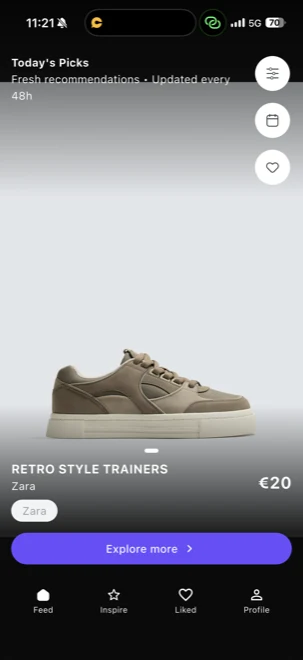
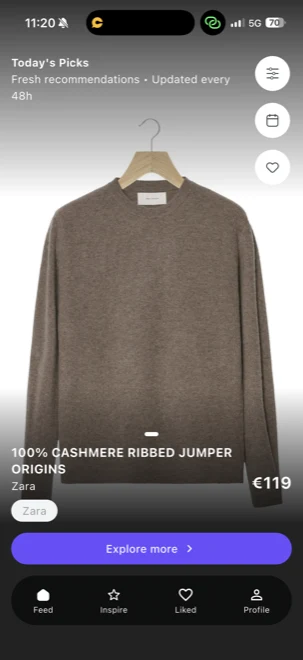
Product architecture
- 1
Flutter client
One codebase shipping to iOS and Android, distributed through TestFlight.
- 2
Xano backend
Authentication, data model and REST endpoints backing the product.
- 3
Azure ML
Model inference wired directly into the product flow.
Client system — no source, no client data. A demo showing the per-garment detection, the interpretable vector space and the brand-diversity pass is running and screenshotted in Style DNA.
The problem
Pikora started as an existing web application that needed frontend development support. Over time, the product vision expanded significantly — the team needed a full mobile app rebuild that could deliver the same (and more) functionality across platforms, backed by a structured backend and integrated machine learning services.
The challenge was not just building screens. It was stepping from frontend contribution into end-to-end product ownership across a completely different tech stack.
My role
In Phase 1, I worked on the Pikora web frontend — contributing to the existing product, implementing UI features, and working within established architecture and product flows. This stage was about delivery within an existing system.
In Phase 2, the scope expanded dramatically. I moved into end-to-end app ownership covering:
- Flutter mobile frontend — cross-platform app architecture, state management, and UI implementation
- Xano backend — data model design, endpoint structure, workflow logic, auth, and API contract alignment
- Azure ML integration — connecting the app to a machine learning service layer for intelligent features
What I built
Phase 1: Web frontend
- Feature implementation within a live React-based product
- Adapting to existing component architecture and product patterns
- Delivering client-facing application logic on schedule
Phase 2: Full product stack
- Mobile app: Flutter-based cross-platform application with production-ready navigation, state management, and responsive layouts
- Backend architecture: Designed data models, REST endpoints, and workflow logic in Xano — handling auth, permissions, and client/backend contracts
- ML service layer: Integrated Azure ML as a separate intelligence layer, separating model-serving concerns from core application logic
- API coordination: Ensured clean contracts between mobile frontend, backend, and ML services
Architecture
The system follows a three-layer architecture:
- Flutter mobile app — handles all user interaction, state, and rendering
- Xano backend — manages data persistence, business logic, auth, and serves as the API gateway
- Azure ML — provides the machine learning inference layer, called by the backend when intelligent features are needed
This separation means each layer can evolve independently — the ML models can be retrained without touching the app, and the backend can be extended without rebuilding the frontend.
What this project proved
Pikora is the clearest example of growth in my portfolio. The progression from Phase 1 to Phase 2 shows:
- From feature work to product ownership — I wasn't just building screens anymore; I was shaping how the entire stack worked together
- From web to mobile — Flutter delivery proved I'm not confined to browser-based products
- From consuming APIs to designing them — The Xano backend required real data model and API design thinking
- From standard apps to ML-connected systems — The Azure ML layer meant the architecture had to account for model serving, latency, and separation of concerns
Outcome
Pikora Phase 2 delivered a production-ready cross-platform mobile application backed by a structured backend and ML integration — a significant leap from the initial frontend contribution scope. The project demonstrated the ability to grow with a product rather than just execute assigned tickets.